
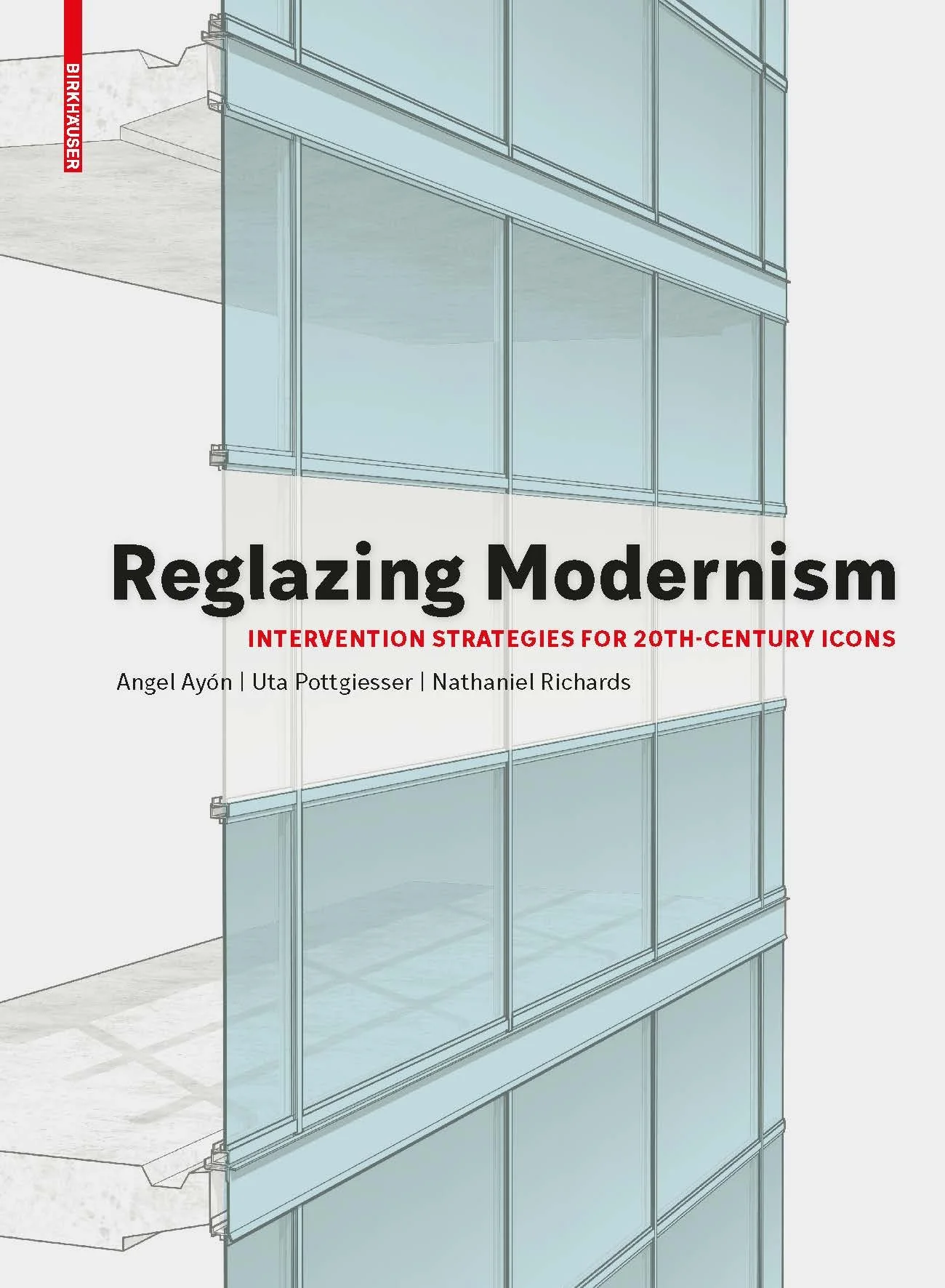
Reglazing Modernism: Intervention Strategies for 20th-Century Icons (Birkhäuser, 2019)
Winner of the 2021 Lee Nelson Book Award
The extensive use of exterior glazed enclosures is one of the most character-defining features of Modern architecture. After decades of service, many Modern buildings from the pre- and post-war periods of the 20th century have deteriorated and have required various types of intervention to address decay, reestablish functionality and improve appearance or performance.
This book presents 20 international case studies of culturally-significant Modern buildings in the U.S. and Europe where the original window walls, curtain walls or ribbon windows have been intervened with according to different criteria and with varying outcomes. With case studies organized under either Restoration, Rehabilitation or Replacement, these three main intervention categories are expanded into further intervention strategies that portray a wide range of options for reglazing Modernism.
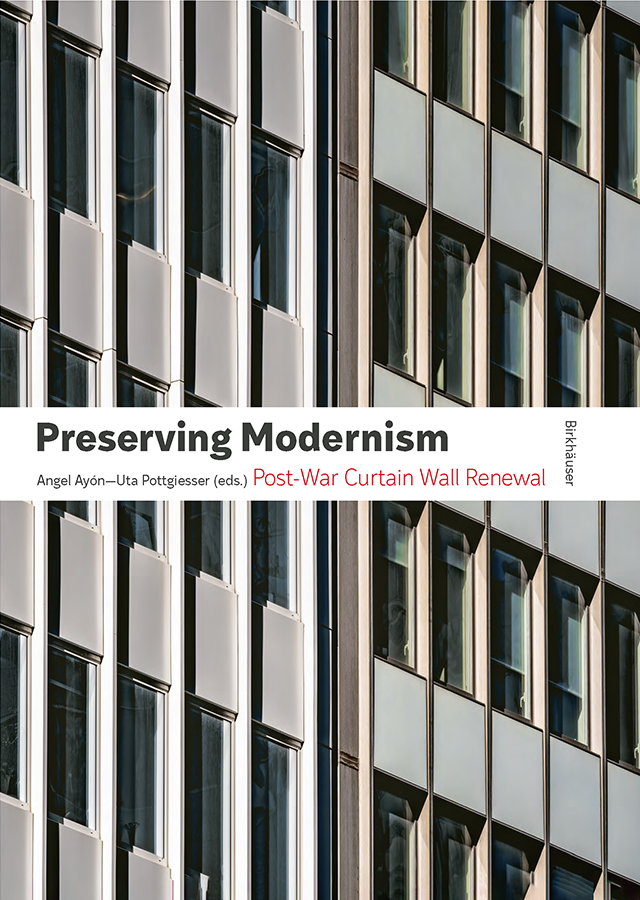
Preserving Modernism: Post-War Curtain Wall Renewal
(Birkhäuser, 2026)
Postwar Modernism’s most defining element – the glass and aluminum curtain wall – is also its greatest vulnerability. Designed as thin, industrialized systems, these systems now face failure and potential demolition due to aging materials, poor performance, obsolescence, and rising environmental demands. Preserving them requires balancing building physics, heritage conservation, and real estate pressures.
Following a concise history of the modern curtain wall, this publication presents selected case studies – from 100 Park Avenue (Kahn & Jacobs, 1949) and the Pfizer Building (Emery Roth & Sons, 1961) in New York to Great Arthur House in London (Chamberlin, Powell and Bon, 1957) and the Rotterdam Library in the Netherlands (Van den Broek and Bakema, 1983) – and analyzes rehabilitation, overcladding, and replacement as primary intervention strategies for curtain wall renewal.
Keep up with Reglazing Modernism and Preserving Modernism on social media:
© 2019 Birkhauser Verlag GmbH, Basel
P.O. Box 44, 4009 Basel, Switzerland
Part of Walter de Gruyter GmbH, Berlin/Boston
256 pages | 300 Figures (c)
Hardcover:
RRP *€ [D] 59.95 / *US$ 68.99 / *GBP 54.50
ISBN 978-3-0356-1845-7
eBook:
RRP *€ [D] 59.95 / *US$ 68.99 / *GBP 54.50
PDF ISBN 978-3-0356-1934-8
Date of Publication: October 2019
Language of Publication: English
Subjects:
Architecture > History > Conservation, Preservation, Restoration
Architecture > Architects, Buildings
Architecture > Materials
Architecture > Construction
Of interest to: preservationists, architects, engineers, clients, students
© 2026 Birkhauser Verlag GmbH, Basel
P.O. Box 44, 4009 Basel, Switzerland
Part of Walter de Gruyter GmbH, Berlin/Boston
240 pages
Hardcover:
US$ 66.99
ISBN 978-3-0356-3021-3
eBook:
US$ 66.99
PDF ISBN 978-3-0356-3022-0
Date of Publication: October 2026
Language of Publication: English
Subjects:
Architecture > History > Conservation, Preservation, Restoration
Architecture > Architects, Buildings
Architecture > Materials
Architecture > Construction
Of interest to: preservationists, architects, engineers, clients, students